
Blueocean Logo
Menu
About Us
Home
Language
Banner Image

Navigate Complex Trade Lanes With Confidence, Precision, and Credentials

Logistics Management
/
Certified Shipping & Freight Forwarding Professional

Course Overview

0

Learners enrolled

CSFFP

Certified Shipping & Freight Forwarding Professional

Designed for both emerging professionals and experienced practitioners, the program bridges the gap between operational knowledge and strategic execution. Learners gain hands-on exposure to shipping documentation, carrier negotiation, digital freight tools, and regulatory compliance — skills directly applicable across logistics, trading, and supply chain functions.

Upon completion, CSFFP-certified professionals are equipped to take on roles as Logistics Coordinators, Shipping Officers, and Supply Chain Executives — backed by a credential recognized and valued by employers across global markets.

Logo

What You Will Learn

The main objectives of the course are:

  • Understand international trade flows and the end-to-end shipping process
  • Manage import and export operations with efficiency and accuracy
  • Prepare and handle shipping documentation in full legal compliance
  • Apply global trade regulations, Incoterms® 2020, and customs requirements
  • Select the optimal transportation mode based on cargo type and business need
  • Calculate freight costs, surcharges, and total landed cost
  • Identify and mitigate operational risks across logistics and cargo handling
  • Leverage digital freight tools and emerging logistics technologies
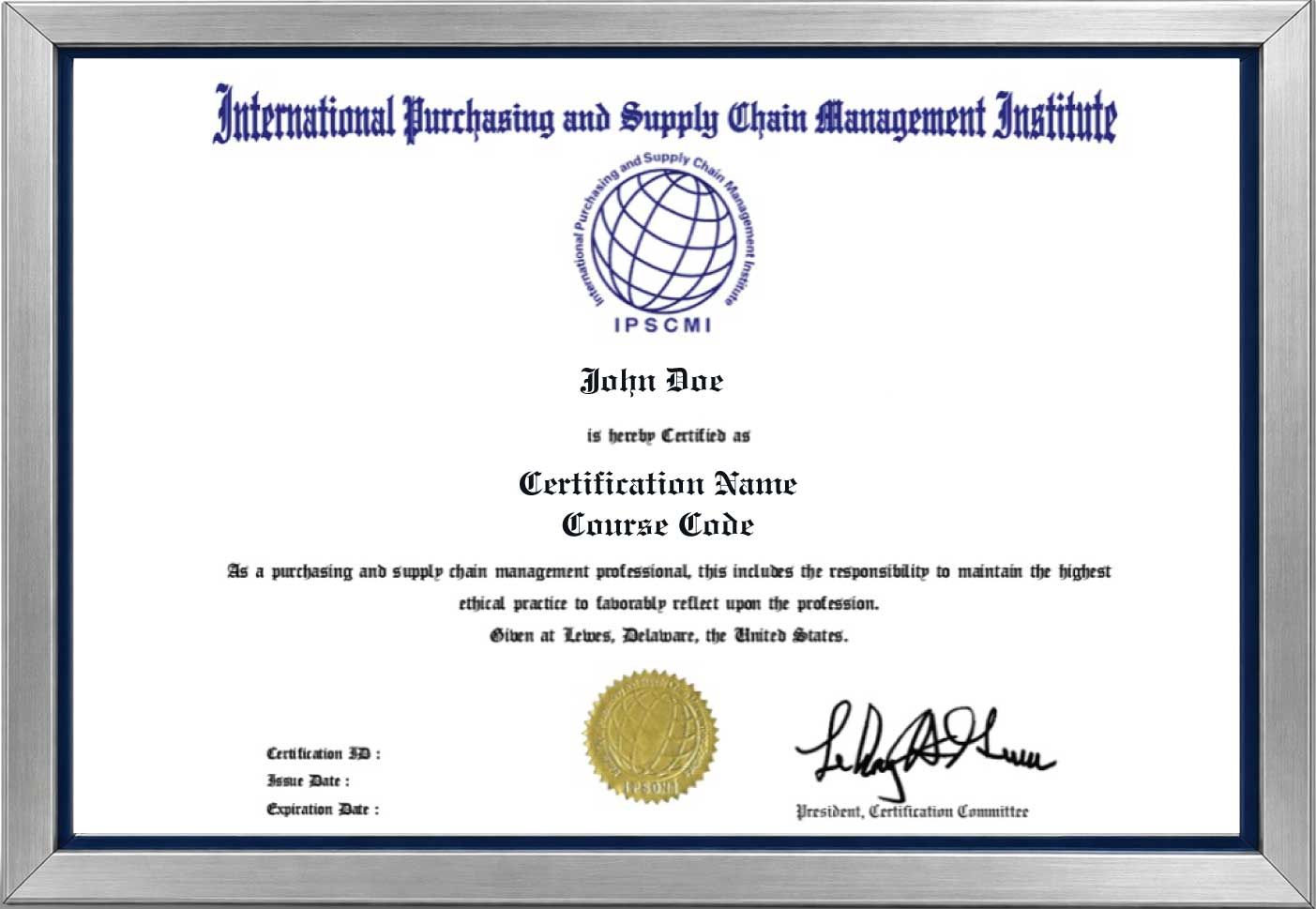
The Certified Shipping & Freight Forwarding Professional (CSFFP), awarded by the International Purchasing and Supply Chain Management Institute (IPSCMI), is a comprehensive certification program built for the realities of modern international trade. Across 11 structured modules, learners develop deep competency in global supply chain integration, transportation mode selection, customs clearance, freight costing, cargo risk management, and sustainable logistics — culminating in a capstone project that simulates real-world end-to-end shipment planning.

Who Should Enroll

  • Logistics and freight forwarding professionals seeking formal certification
  • Import/export executives and trade compliance officers
  • Supply chain and procurement professionals expanding into logistics
  • Shipping coordinators and operations staff at freight forwarding or trading companies
  • Professionals transitioning into international trade and logistics roles
  • Business owners and managers involved in cross-border commerce
  • Recent graduates pursuing careers in global trade, logistics, and supply chain management

Skills You Will Build

  • End-to-end international shipment planning and execution
  • Customs clearance navigation and HS code classification
  • Freight pricing analysis and carrier negotiation
  • Shipping documentation preparation and compliance management
  • Risk assessment and marine insurance application
  • Incoterms® 2020 interpretation and contractual application
  • Multi-modal transportation evaluation (sea, air, road, and rail)
  • Digital logistics tool adoption and integration
  • Sustainable and ESG-aligned logistics decision-making
Target Competencies
  • Global Trade Networks and Supply Chain Structures
  • Transportation Mode Selection and Freight Strategy
  • Documentation and Regulatory Compliance
  • Freight Costing, Surcharges, and Cost Optimization
  • Cargo, Liability, and Insurance Risk Management
  • Freight Execution and Stakeholder Coordination
  • Digital Freight Management Platforms
  • Green Logistics and Carbon Compliance
Student

Module 1 – Global Trade Networks & Supply Chain Integration

Module 1: The Global Trade Landscape and the Freight Ecosystem

  • Why Global Trade Depends on Freight Forwarding
  • Major Trade Lanes and Cargo Flows
  • The End-to-End Supply Chain of a Shipment
  • Institutions, Regulators, and Trade Bodies

Module 2: Global Shipping and Freight Forwarding Fundamentals

  • The Role of the Freight Forwarder in Global Trade
  • Major Trade Lanes and Global Cargo Flows
  • How the Freight Ecosystem Fits Together
  • Modes of Transport and Their Trade-offs

Module 3: Freight Stakeholders and Service Providers

  • Shippers, Consignees, and Notify Parties
  • Carriers, NVOCCs, and Shipping Lines
  • 3PLs, 4PLs, and Logistics Service Models
  • Customs Brokers, Agents, and Terminal Operators

Module 4: Ocean Freight Operations

  • FCL versus LCL Shipments
  • Container Types and Specifications
  • Vessel Operations and Sailing Schedules
  • Port Operations and Terminal Handling

Module 5: Ocean Freight Booking, Charges, and Demurrage

  • The Ocean Booking Process
  • Freight Quotations and Rate Components
  • Demurrage, Detention, and Free Time
  • Port and Terminal Charges

Module 6: Air Freight Operations

  • Air Cargo Fundamentals and the IATA Framework
  • The Air Waybill and Air Freight Documentation
  • Chargeable Weight and Volumetric Calculations
  • Consolidation and Time-Critical Cargo

Module 7: Multimodal and Intermodal Transport

  • Multimodal versus Intermodal Concepts
  • Road and Rail in the Transport Chain
  • Transport Corridors and Land Bridges
  • Cross-Border Logistics and Handover Points

Module 8: Dangerous Goods and Specialised Cargo Handling

  • Classifying Dangerous Goods: IMDG, IATA DGR, and ADR
  • Reefer, Perishable, and Temperature-Controlled Cargo
  • Project, Out-of-Gauge, and Break-Bulk Cargo
  • Packing, Marking, and Labelling Requirements

Module 9: Incoterms 2020

  • Purpose and Structure of the Incoterms Rules
  • The Eleven Incoterms Explained
  • Allocating Cost, Risk, and Responsibility
  • Choosing the Right Incoterm in Practice

Module 10: International Trade Documentation

  • Commercial Invoices and Packing Lists
  • Bills of Lading and Air Waybills
  • Certificates of Origin and Inspection Documents
  • Documentary Accuracy and Common Errors

Module 2 – Strategic Selection of Transportation Modes

  • Distinguish sea, air, road, and rail freight
  • Analyze FCL vs. LCL scenarios
  • Evaluate specialized and project cargo requirements
  • Make informed transportation mode selection decisions

Module 3 – Mastering Shipping Documentation & Compliance

  • Identify essential shipping documents
  • Explain legal roles and document functions
  • Assemble a complete export-import documentation set
  • Ensure compliance across shipping operations

Module 4 – Applying Incoterms® 2020 in International Trade

  • Identify and distinguish the 11 Incoterms® 2020 rules
  • Analyze cost and risk transfer points
  • Recognize common usage mistakes
  • Understand contractual implications

Module 5 – Navigating Customs Clearance & Regulatory Requirements

  • Describe the customs clearance process
  • Classify goods using HS Codes
  • Calculate duties, tariffs, and levies
  • Ensure compliance with restricted goods regulations

Module 6 – Freight Pricing, Costing & Carrier Negotiation

  • Compare air, sea, and road freight rate structures
  • Analyze surcharges and their impact on total cost
  • Calculate total landed cost accurately
  • Negotiate with carriers on cost and service levels

Module 7 – Mitigating Risks: Insurance, Liability & Claims

  • Identify core cargo risks
  • Explain marine insurance fundamentals
  • Understand freight forwarder liability
  • Navigate the cargo claims process

Module 8 – Executing Freight Operations & Stakeholder Coordination

  • Describe end-to-end shipment execution
  • Identify operational steps and stakeholders
  • Explain carrier coordination and shipment tracking
  • Apply last-mile delivery and communication practices

Module 9 – Leveraging Digital Tools & Future Logistics Trends

  • Identify core digital freight tools
  • Explain key functions and commercial value
  • Analyze practical applications and emerging trends
  • Develop digital integration strategies

Module 10 – Sustainable & Green Logistics Strategies

  • Understand carbon footprint measurement
  • Evaluate green freight initiatives
  • Explain ESG relevance in logistics
  • Analyze sustainability trends and compliance requirements

Module 11 – Capstone Project: Planning an End-to-End International Shipment

  • Integrated shipment planning
  • Transportation mode selection and justification
  • Incoterms® application and documentation
  • Costing, customs clearance, and compliance execution

Select a Batch Timeline

Please ensure you select both your preferred batch and time slot to confirm your enrollment.

*Select Batch

No Upcoming Batches

Course Fees
$1,199
Boa mask

Build Your Skills. Advance Your Career.

BOA
App is now available on
App StoreGoogle Play
Sitemap|FAQ|Terms & Conditions|Privacy Policy|Cancellation Policy
Blue Ocean Corporation © All Rights Reserved