

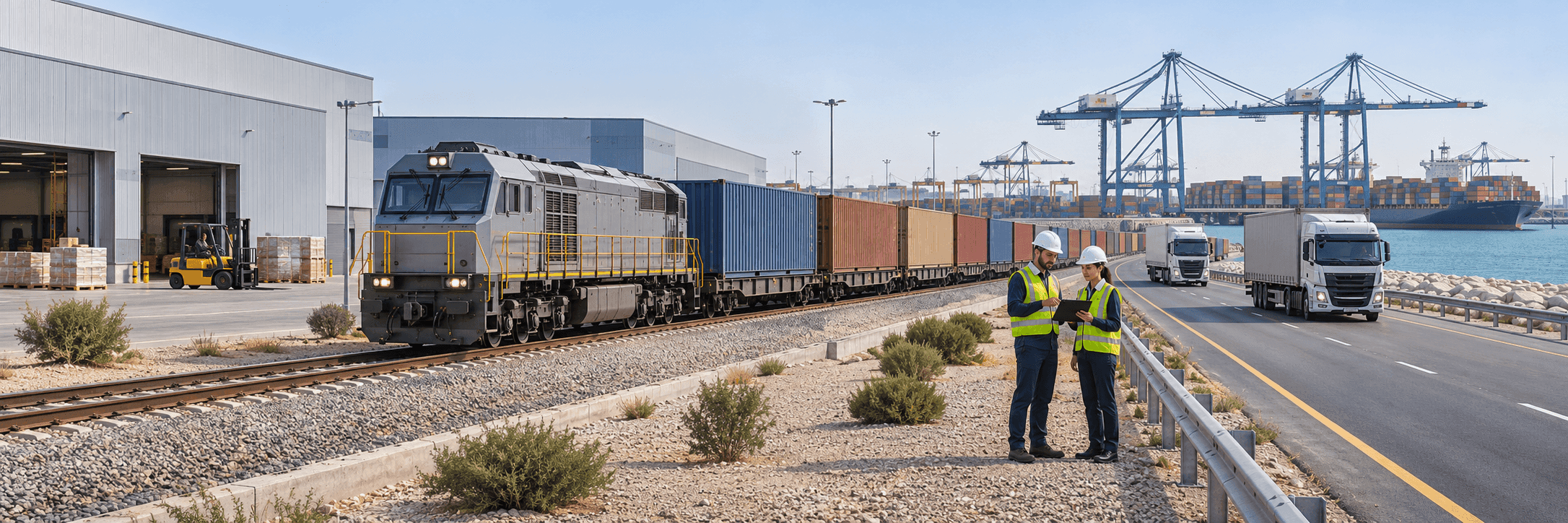
A shipment leaves a factory in Abu Dhabi. A truck carries it to a freight terminal, where the cargo is loaded onto a train. After crossing the country, another truck collects it from the receiving terminal and completes the delivery.
The goods reach the same destination, but the journey is no longer entirely dependent on road transport.
This is the change Etihad Rail is bringing to UAE logistics. It gives businesses another way to move heavy and high volume cargo while creating new decisions for transport planners, warehouse teams, and supply chain professionals.
Etihad Rail is no longer only a future project. Freight services are operating, passenger trains are running, and more stations are scheduled to open.
Freight rail is already moving the UAE
Etihad Rail launched national freight operations in 2023. Its network stretches for approximately 900 kilometers, connecting industrial areas, ports, logistics centers, and cities from Ghuwaifat near the Saudi border to Fujairah.
Freight operations are active across 11 terminals and four major ports. The network can carry bulk materials, construction products, industrial cargo, finished vehicles, and other goods that need to move in large quantities.
According to Etihad Rail, one freight train can replace up to 300 trucks on the road. This can reduce the number of heavy vehicle movements while giving suitable industries another way to plan regular cargo flows. Etihad Rail freight services corporate.etihadrail.ae
That does not mean trucks will disappear.
A train cannot collect cargo from every factory or deliver directly to every warehouse and customer. Trucks will continue to handle collection, local distribution, urgent shipments, and connections between businesses and rail terminals.
The future is not rail against road. It is rail and road working together.
Logistics teams have a new question to ask
When planning a shipment, we usually consider cost, delivery time, cargo size, distance, and customer expectations.
Etihad Rail introduces another question: could part of this journey move by train?
The answer depends on the shipment. A small urgent order may still need direct road or air transport. Rail may be more suitable for regular cargo volumes that can be planned in advance.
The decision should look beyond the rail rate. A company must consider the cost of moving cargo to the terminal, handling it, loading it, collecting it at the other end, and completing the final delivery.
Reliability matters too. Planned rail movements may help suitable businesses reduce their exposure to normal road congestion and organize larger cargo volumes more predictably.
Professionals who want to understand transportation planning, freight operations, distribution networks, and logistics performance can explore Blue Ocean Academy’s Mastering Logistics and Transportation program.
The journey does not end at the terminal
Imagine a freight train arriving at 7:00 in the morning. Trucks are expected to collect the cargo, and the warehouse has prepared space for it.
If the trucks arrive late, the cargo may remain at the terminal. If the warehouse is not ready, unloading and receiving may be delayed. A missing document or unavailable piece of equipment could slow the process further.
The train may have completed its part perfectly, but the complete shipment can still fall behind schedule.
This is why rail planning must connect with factories, ports, road transport, warehouses, customs processes, and customers. Every team needs accurate information and clear timing.
Logistics professionals will increasingly need to understand the complete movement rather than one transport activity in isolation.
Passenger rail has started operating
Passenger services are no longer simply planned for the future.
As of November 2026, Etihad Rail passenger trains connect Abu Dhabi, Dubai, Al Dhaid, and Fujairah. The network will continue to expand in stages.
Zayed City and Liwa stations are scheduled to open on November 30, 2026. The remaining Al Dhafra stations are scheduled for December 30, 2026. Sharjah Station is expected to open on March 30, 2027.
Passenger and freight services have different customers, but they depend on many similar capabilities. Both need reliable schedules, safe operations, maintained equipment, digital systems, trained employees, and clear communication.
Rail careers extend beyond driving trains
When we hear the words railway career, train captain may be the first role that comes to mind. A national railway, however, needs a much wider workforce.
Traffic controllers monitor train movements and schedules. Maintenance teams look after locomotives, railway systems, signaling equipment, and stations. Freight employees coordinate cargo handling, loading, unloading, and documentation.
Technology professionals support ticketing, data, communications, security, and operational systems. Customer service employees help passengers with routes, tickets, and station information. Procurement and logistics teams source services, manage suppliers, and coordinate rail with warehouses, ports, and trucks.
Opportunities may also develop outside Etihad Rail. Transport companies, terminal operators, maintenance providers, manufacturers, ports, warehouses, and technology companies may all require people who understand rail connected logistics.
Skills that will matter
Transport planning will be one of the most useful skills. Professionals must understand when to use road, rail, sea, or air transport based on cargo type, volume, cost, urgency, and customer requirements.
Coordination will matter just as much. A rail movement may depend on trucks reaching the terminal on time, a warehouse preparing space, and the customer being ready to receive the cargo.
Data skills will help teams monitor schedules, capacity, shipment status, delays, costs, and service performance. Technology can provide the information, but people must still interpret it and decide what action to take.
Safety knowledge will remain essential. Railway and terminal operations involve heavy equipment, controlled areas, and several teams working together.
Sustainability is also becoming part of logistics planning. Etihad Rail states that rail produces lower emissions per tonne of cargo than road transport. It has also introduced certificates that help freight customers measure avoided emissions.
Warehouses must prepare for rail movements
Warehouses receiving cargo from trains must plan around scheduled arrivals. They need enough storage space, available employees, working equipment, and accurate documents.
A train may bring a larger quantity of cargo at one time than several smaller truck deliveries. Warehouse managers may therefore need to adjust receiving schedules, labor plans, yard movements, and storage locations.
The connection works in both directions. Cargo leaving a warehouse for a rail terminal must be prepared on time. Missing the planned train movement could delay the entire shipment.
Transportation and warehouse teams cannot plan separately. Each operation affects the other.
Businesses can begin with their own data
A company does not need to move every shipment by train to start preparing.
It can review its regular transport routes, cargo volumes, delivery schedules, and proximity to rail terminals. It can identify where delays occur and which products move in predictable quantities.
The company should then compare the complete logistics cost. Rail charges, truck connections, handling, terminal activity, storage, waiting time, documentation, and inventory must all be considered.
The decision should involve logistics, finance, procurement, production, warehousing, customer service, sustainability, and technology teams.
Professionals looking to build broader expertise can explore Blue Ocean Academy’s Logistics Management programs.
Etihad Rail changes more than the route
Etihad Rail gives UAE businesses another way to move suitable cargo. It also creates stronger links between rail, road, warehouses, ports, and industrial areas.
The important question is no longer only which truck should carry a shipment. We can now ask whether rail should handle part of the journey, whether the warehouse is ready, and whether our teams have the skills to coordinate the movement.
The infrastructure is operating. The next opportunity lies in how well businesses and professionals use it.
Explore Mastering Logistics and Transportation or contact Blue Ocean Academy for program guidance.
Frequently Asked Questions
Is Etihad Rail freight service operating?
Yes. National freight operations have been running across the UAE network since 2023.
Has Etihad Rail passenger service started?
Yes. Passenger services currently connect Abu Dhabi, Dubai, Al Dhaid, and Fujairah, with more stations scheduled to open.
Will rail replace trucks?
No. Trucks will continue to collect cargo, complete local deliveries, and connect businesses with rail terminals.
Which careers may benefit from Etihad Rail?
Relevant areas include transport planning, terminal operations, maintenance, cargo handling, safety, technology, warehousing, procurement, and customer service.
Which skills should logistics professionals develop?
Useful skills include transport planning, freight coordination, warehouse operations, safety, data interpretation, cost analysis, sustainability, and communication.
