


A supplier receives two tender invitations in the same week.
The first tender is connected to Aramco and asks for IKTVA information. The second comes from a government entity and refers to local content and the Mandatory List.
Both requests appear to ask the same question: how much value does the company create inside Saudi Arabia?
The supplier prepares one file for both opportunities. A few days later, the procurement teams request different documents. The supplier must now revise both submissions while the deadlines are getting closer.
This situation is common because IKTVA and government local content requirements support a similar national goal. However, they belong to different procurement systems. Understanding that difference can help suppliers avoid incomplete bids and help buyers communicate their requirements clearly.
Local content begins with where the money goes
Local content is the economic value a company creates inside Saudi Arabia.
This value can come from purchasing Saudi products, using local service providers, employing Saudi professionals, developing skills, investing in facilities, or completing manufacturing activities inside the Kingdom.
Consider two suppliers offering the same industrial equipment.
The first supplier imports the finished equipment and delivers it to the customer. The second completes part of the manufacturing in Saudi Arabia, purchases packaging locally, employs Saudi technicians, and uses a Saudi maintenance company.
Both suppliers may meet the technical requirements. However, the second creates more business activity inside Saudi Arabia.
Local content helps buyers see this wider contribution. It allows them to look beyond the final price and understand where the value is being created.
A Saudi commercial registration alone does not show the complete picture. Buyers may also ask for evidence of local spending, employment, investment, operations, and supplier development.
IKTVA measures local value in the Aramco supply chain
IKTVA stands for In Kingdom Total Value Add.
Aramco introduced the program to strengthen its supply chain and increase the value created within Saudi Arabia. It encourages suppliers to develop local manufacturing, services, employment, skills, investment, and innovation.
A company working with Aramco may be asked to provide IKTVA information during registration, qualification, bidding, or supplier reviews.
An IKTVA assessment may consider:
- Spending on goods and services in Saudi Arabia
- Saudi employment and workforce development
- Local assets and investments
- Research and development activities
- Manufacturing and service capabilities
- Exports from Saudi Arabia
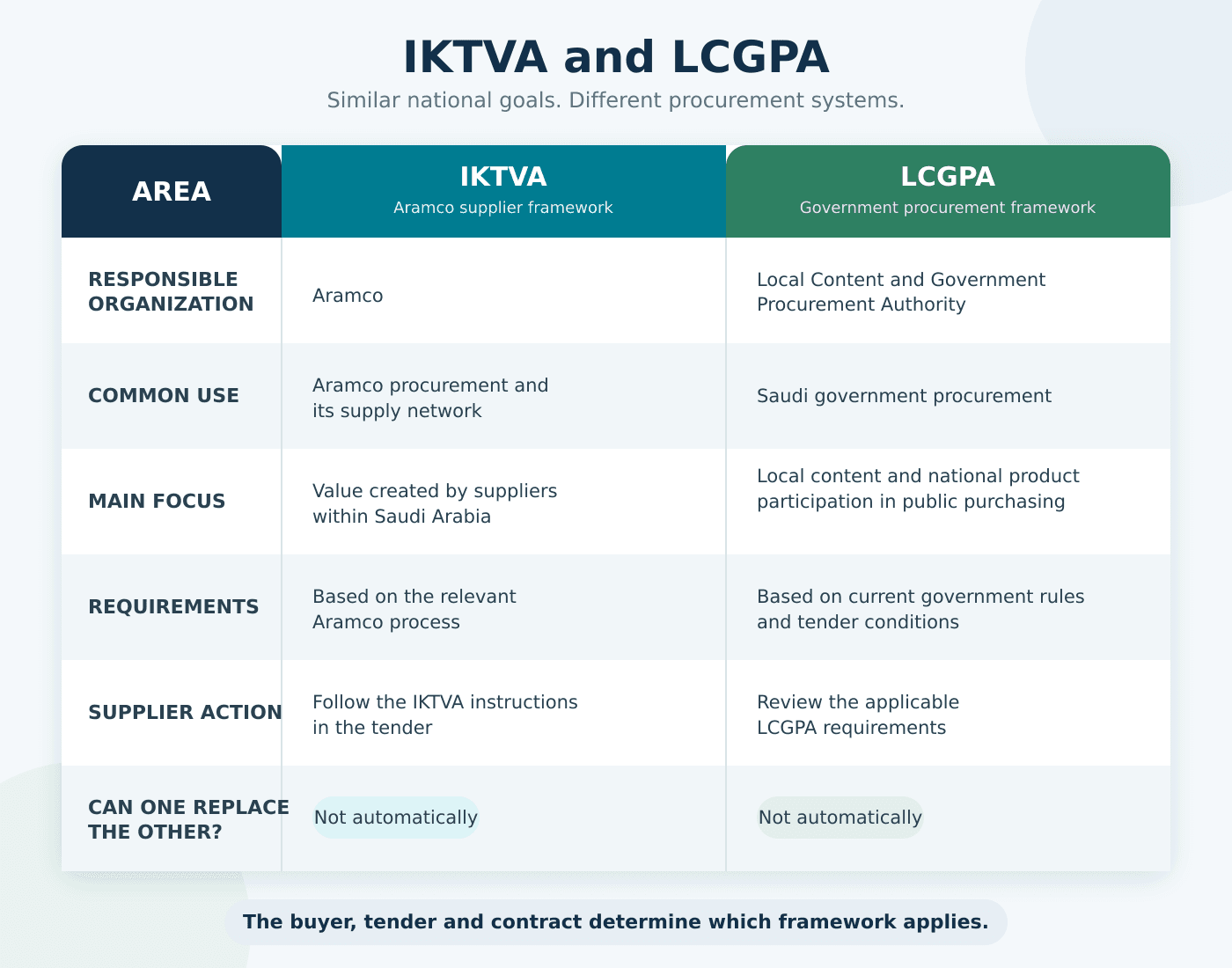
The documents and calculations depend on the current Aramco process. Suppliers should follow the instructions in the relevant tender instead of relying on information prepared for an older bid.
Aramco describes IKTVA as a program that supports supply chain efficiency, local business development, investment, and a more competitive Saudi energy sector.
Why IKTVA matters during supplier evaluation
An IKTVA result helps Aramco understand how much value a supplier creates within Saudi Arabia.
Price, quality, safety, technical performance, experience, and delivery remain important. IKTVA provides an additional view by showing how the supplier supports local economic activity.
Suppose two suppliers meet the technical requirements and offer similar prices. One imports almost everything. The other purchases locally, trains Saudi employees, and invests in a facility inside the Kingdom.
The buyer can compare not only their products and prices but also their contribution to the Saudi economy.
A stronger IKTVA result does not guarantee a contract. The tender documents decide how the information will be evaluated.
LCGPA rules guide government procurement
LCGPA stands for the Local Content and Government Procurement Authority.
The Authority develops and supports local content requirements within Saudi government procurement. These requirements can affect tenders issued by ministries, government entities, and other organizations covered by the relevant rules.
A government tender may include conditions related to national products, local content, supplier qualification, or the Mandatory List.
This creates an important distinction.
IKTVA is mainly connected to Aramco procurement. LCGPA requirements operate within the government procurement framework.
Both encourage value creation inside Saudi Arabia, but they do not use one universal process or document. An IKTVA submission may not meet the requirements of a government tender.
IKTVA and LCGPA serve different procurement systems
The Mandatory List can affect product selection
The Mandatory List covers specified national products within applicable government procurement.
When a product appears on the list, a government buyer may need to apply the relevant national product rules. Suppliers may also need to submit documents showing that the offered product meets the stated requirements.
This can affect specifications, supplier selection, bid evaluation, and contract monitoring.
The Mandatory List should not be treated as one fixed percentage for every tender. Product requirements and official documents may change. Procurement teams should review the current list instead of copying information from another project.
One product can face two sets of requirements
Consider a company supplying industrial pumps.
The company first bids for an Aramco project. The tender asks for IKTVA information, so the supplier prepares records covering local purchases, Saudi employees, investments, and operations.
A month later, the company offers the same pump in a government tender. This tender refers to the Mandatory List and national product requirements.
The product has not changed, but the procurement framework has.
Before preparing a response, suppliers should confirm:
- Who issued the tender
- Whether IKTVA is requested
- Whether LCGPA requirements apply
- Whether the product appears on the Mandatory List
- Which supporting documents are required
- How local content will affect the evaluation
These checks can prevent missing documents and last-minute revisions.
Prepare the evidence before a tender arrives
Local content information is rarely held by one department.
Finance may hold spending records. Procurement manages supplier information. Human resources holds employee and training data. Operations maintains details about facilities, equipment, and production.
Suppliers can prepare a central file containing:
- Company registration details
- Local purchasing records
- Supplier contracts and invoices
- Saudi employment information
- Employee training records
- Local asset and investment details
- Manufacturing and service records
- Evidence supporting each local content claim
The information should be current and connected to the legal entity submitting the bid.
Teams responsible for sourcing and supplier evaluation can strengthen their capabilities through Blue Ocean Academy’s Mastering Strategic Procurement program.
Buyers need clear requirements
Buyers should identify the correct framework before issuing a tender.
The tender should explain which information is required, which supplier entity must provide it, which supporting documents are acceptable, and how local content will affect the evaluation.
Clear instructions help suppliers prepare complete bids. They also make comparisons easier to record and explain.
Buyers should avoid asking for general “local content documents” without naming the framework. Such wording can produce inconsistent submissions.
Mistakes that can weaken a bid
The first mistake is assuming IKTVA applies to every Saudi tender. It does not.
The second is treating IKTVA and LCGPA as the same system. Their objectives may be similar, but their scope and documents can differ.
Suppliers should also avoid using unsupported percentages or figures copied from old tenders.
Local content should not be left entirely to finance. Procurement, human resources, operations, and management may all hold information needed for the submission.
Local content should create business value
Local sourcing may shorten delivery routes and improve availability. Local production can reduce supply risks. Training Saudi professionals can build skills needed for future projects.
However, localization decisions must still make commercial sense. Buyers should consider cost, quality, safety, capacity, risk, and delivery alongside local content.
The aim is not to chase a score at any cost. It is to create genuine value inside Saudi Arabia while meeting the needs of the project.
Ready to strengthen your procurement team? Enquire about the Mastering Strategic Procurement program.
This article provides general information and does not constitute legal or procurement advice. Always review current official guidance and the relevant tender documents.
Frequently asked questions
Does every Saudi company need an IKTVA score?
No. IKTVA is mainly relevant to suppliers working with Aramco and its supply network.
Can an IKTVA submission be used for an LCGPA tender?
Not automatically. Government tenders may require different documents and evidence.
When does the Mandatory List apply?
It applies within relevant government procurement. Buyers and suppliers should check the current list and tender conditions.
Does a stronger local content result guarantee a contract?
No. Price, quality, safety, technical performance, experience, risk, and delivery may also affect the decision.
Which records should suppliers prepare?
Suppliers should maintain local purchasing, workforce, training, investment, asset, manufacturing, and service records.
Where can companies check current requirements?
Use official Aramco information for IKTVA, official LCGPA guidance for government procurement, and the latest tender documents.
