


The procurement team entered the meeting expecting a routine supplier review.
On the screen was a list of more than 200 vendors. Some supplied office materials. Others provided uniforms, spare parts, software, and technical services. Finance wanted to reduce spending, operations wanted faster deliveries, and management wanted fewer suppliers.
The first suggestion sounded reasonable.
“Let us begin with the suppliers receiving the most money.”
The team sorted the spreadsheet from highest to lowest annual spending. A uniform manufacturer appeared near the top. An office supplier sat somewhere in the middle. A small technical distributor was almost at the bottom.
The technical distributor received less than AED 25,000 a year. Compared with the larger contracts, it did not appear important.
Then the facilities manager asked a simple question.
“Do we know what that supplier provides?”
The room became quiet.
The distributor supplied one specialist control component used in the cooling systems across several facilities. The component was purchased only when a unit failed, but no other approved supplier held it locally.
If the distributor could not deliver, part of a facility might operate with limited cooling until a replacement arrived from overseas.
The supplier with one of the smallest purchase values had suddenly become one of the most important names in the room.
That moment changed the discussion. The team realized that spending alone could not show which suppliers required the most attention.
They needed a better way to look at the list.
The question behind the Kraljic Matrix
The team stopped asking, “How much do we spend?”
Instead, they asked two questions.
How much would the business be affected if this product or service became unavailable?
How difficult would it be to find a suitable replacement?
Those two questions form the basis of the Kraljic Matrix.
Peter Kraljic introduced the model in his 1983 Harvard Business Review article, Purchasing Must Become Supply Management. He encouraged companies to move
The idea is simple. Every purchase category is assessed by its business impact and supply risk.
Business impact may come from spending, revenue, quality, safety, customer service, or operational importance. Supply risk may come from limited suppliers, long delivery times, technical requirements, imports, or a lack of suitable alternatives.
Together, these factors create four sections.
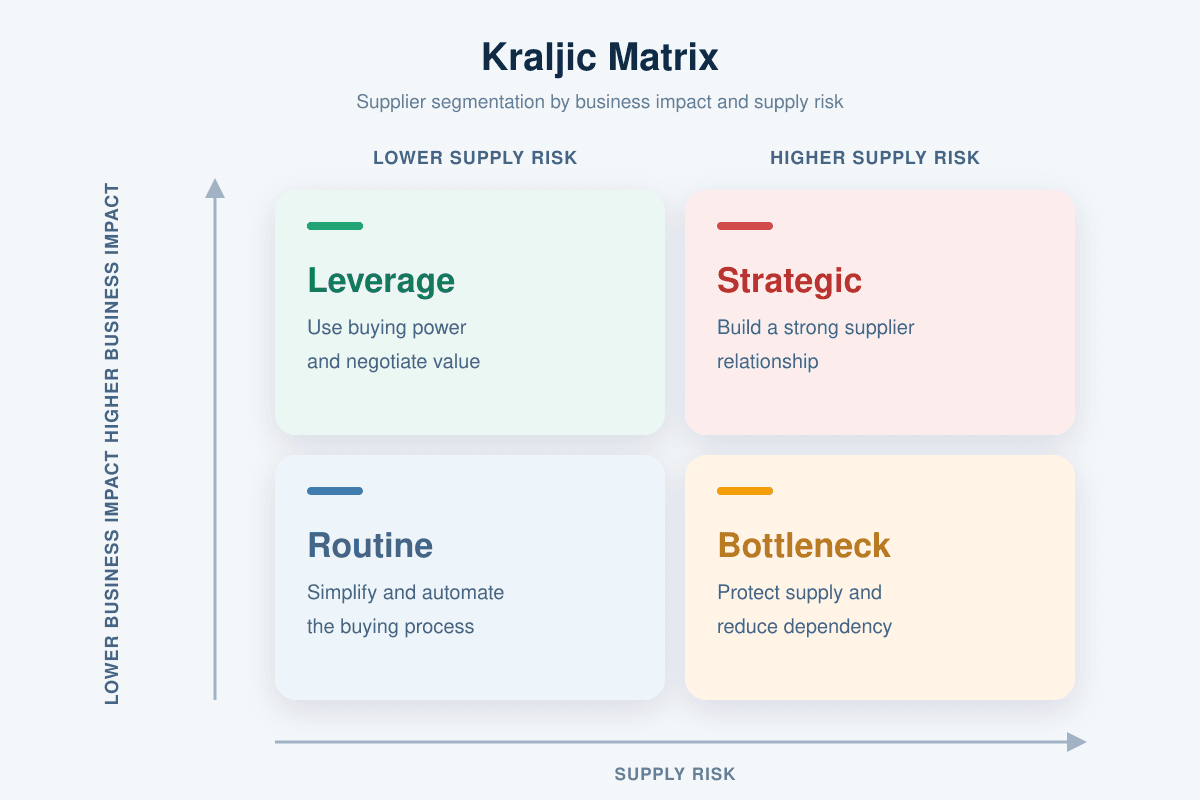
The names sounded technical at first. Once the team discussed its own purchases, however, the four sections became much easier to understand.
The office supply contract was taking too much time
The first category discussed was office supplies.
Every month, different departments requested paper, folders, labels, pens, and other common items. Procurement collected quotations, prepared comparisons, obtained approvals, and issued several purchase orders.
The process was controlled, but it was slow.
Several local suppliers could provide the same products. If the current supplier failed to deliver, another supplier could usually complete the order within a short time. The annual spending was also limited compared with the company’s operational contracts.
The team placed office supplies in the routine section of the Kraljic Matrix.
Routine purchases have lower business impact and lower supply risk. They need control, but they should not consume a large part of the procurement team’s time.
The team decided to create an approved catalog containing frequently ordered items and agreed prices. Departments could select products from the catalog, while procurement reviewed overall spending and supplier performance.
Nothing dramatic changed. There was no major negotiation or new technology project. The company simply removed unnecessary steps from a simple purchase.
That small change gave the team more time to work on categories that genuinely needed attention.
The uniform contract offered a different opportunity
Next came employee uniforms.
The company purchased a large number every year. The category affected spending, employee comfort, safety requirements, and the appearance of customer facing teams.
Unlike the specialist cooling component, uniforms were available from several capable manufacturers across the region. The company was not dependent on one supplier.
The team placed uniforms in the leverage section.
Leverage categories have higher business impact but lower supply risk. The buyer has greater negotiating power because several qualified suppliers want the business.
Previously, each location had ordered uniforms separately. Quantities were smaller, specifications differed, and prices varied.
The procurement team combined the requirements into one category. It agreed on common specifications with the operational departments and invited qualified suppliers to submit offers based on the total expected volume.
The discussion was not limited to unit price. The team reviewed fabric quality, size availability, replacement arrangements, delivery reliability, and payment terms.
One supplier offered the lowest price but required a long production schedule. Another price was slightly higher, but the supplier maintained local stock and could replace damaged uniforms quickly.
The second offer created better overall value.
This is an important lesson in category management strategy. Stronger buying power should help us improve the complete offer, not simply push the price as low as possible.
Professionals who want to develop practical skills in supplier segmentation, category planning, and strategic sourcing can explore Blue Ocean Academy’s Certified International Sourcing Manager program.
The smallest supplier created the biggest surprise
The team then returned to the technical distributor near the bottom of the spending report.
The cooling component was not expensive. The company purchased only a few units each year. Finance had never viewed the category as a major spending concern.
Operations saw it differently.
The component was approved for a particular system. Finding a substitute would require technical testing. The local distributor was the quickest source, while overseas delivery could take several weeks.
The team placed the component in the bottleneck section of the Kraljic Matrix.
Bottleneck categories have lower business impact when measured by spending, but higher supply risk. They often remain unnoticed until something goes wrong.
For this category, aggressive price negotiation was not the priority. Saving a few hundred dirhams would mean very little if a delayed component created a serious operational problem.
The team checked how many spare units were available across its facilities. It reviewed average delivery times and asked the technical department whether another component could be approved.
The distributor was also invited to discuss emergency support and stock availability.
The result was not a cheaper component. It was a safer supply arrangement.
That outcome would never have appeared in a savings report, but it protected the organization from a much larger potential cost.
One software provider required a closer relationship
The final discussion focused on the company’s maintenance management software.
The platform recorded equipment details, assigned tasks, scheduled technicians, tracked service requests, and supported reporting across several locations.
The company had spent years configuring the system and training employees. Replacing the provider would require data migration, system testing, new training, and changes to several internal processes.
The software had a high business impact and a high supply risk. It entered the strategic section.
Strategic categories need more than a contract and an annual price discussion. They require regular communication, performance reviews, risk planning, and involvement from the departments that depend on them.
The procurement team arranged regular meetings with the provider. Information technology reviewed security and system availability. Operations discussed service performance and future requirements. Procurement monitored commercial terms and contract responsibilities.
The company also created a continuity plan. It documented data access, support arrangements, and the steps required if the relationship ended.
A closer relationship did not mean giving the supplier complete freedom. It meant understanding the dependency and managing it carefully.
Four suppliers, four different decisions
By the end of the meeting, the original supplier list looked very different.
The office supply category needed a simpler process.
The uniform category offered an opportunity for stronger competition.
The cooling component needed better supply protection.
The software provider needed a closer and more structured relationship.
All four suppliers were important, but not in the same way.
This is the practical value of the Kraljic Matrix. It prevents procurement teams from giving every category the same amount and type of attention.
Without supplier segmentation, teams may spend hours negotiating small routine purchases while overlooking an inexpensive item that could interrupt operations.
Building your own Kraljic Matrix
A business can begin with its annual purchasing data, but the spreadsheet should be treated as a starting point rather than the complete answer.
Similar purchases can be grouped into categories. Laptops, monitors, and accessories may form a technology equipment category. Cleaning materials may be grouped under facilities supplies.
Procurement should then speak with the departments that use each category. Finance can explain the spending. Operations can describe the effect of a supply failure. Engineering can identify technical restrictions. Information technology can explain how difficult a system would be to replace.
These conversations help the team understand the true business impact.
The team should also study the supplier market. How many capable suppliers are available? Are the products available locally? How long does delivery take? Does the organization depend on a particular manufacturer, distributor, country, or transport route?
Each category can then be positioned in the Kraljic Matrix.
The position should lead to action. Routine categories need efficiency. Leverage categories need informed competition. Bottleneck categories need supply protection. Strategic categories need stronger relationship and risk management.
The matrix is not permanent
Six months after the supplier review, the procurement team returned to the matrix.
A second distributor had started stocking the cooling component locally. The company had also approved an alternative part. Supply risk was becoming lower.
At the same time, one of the uniform manufacturers had closed its regional facility. Delivery times across the market were increasing.
The categories were beginning to move.
This is normal. The Kraljic Matrix should reflect current business and market conditions. It should not remain unchanged simply because a category was placed in one section during the previous review.
New suppliers may enter the market. Regulations may change. Demand may rise. A product may become difficult to import. Technology may create new alternatives.
Regular review keeps the category management strategy connected to reality.
A supplier list tells only part of the story
The procurement meeting began with a simple plan to review the company’s highest spending suppliers.
It ended with a clearer understanding of risk, value, and operational dependency.
The most expensive supplier was not automatically the most dangerous. The smallest purchase was not automatically unimportant. The lowest price was not always the best value.
That is why the Kraljic Matrix remains useful.
It helps procurement teams look beyond invoices and ask what the business truly needs from each category. Sometimes the right answer is to simplify. Sometimes it is to negotiate. Sometimes it is to protect supply. Sometimes it is to build a stronger relationship.
The important thing is knowing the difference.
Frequently Asked Questions
Is the Kraljic Matrix used for suppliers or products?
The Kraljic Matrix is mainly used to assess purchase categories. The position of a category then helps procurement decide how to source it and manage the relevant suppliers.
Can an inexpensive item have a high supply risk?
Yes. A low cost spare part or component can create a serious operational problem when it is difficult to replace. Such an item may enter the bottleneck section.
Can the same category have a different position in another company?
Yes. Its position depends on the organization’s spending, operations, supplier market, location, and access to alternatives.
How often should the Kraljic Matrix be reviewed?
It should be reviewed regularly and whenever there is a major change in demand, supplier availability, technology, regulations, or market conditions.
How does the Kraljic Matrix support category management strategy?
It helps category managers decide where to simplify purchasing, use competition, protect supply, or build stronger supplier relationships. This allows procurement resources to be used where they create the greatest value.
