


It’s 9:00 AM on Monday morning. Your procurement team has just negotiated a key contract, and the vendor delivers a high priority order. The invoice arrives in your inbox as a sleek PDF. Your accounting team checks the numbers, approves the payment, and files the record away for quarterly VAT reporting.
For over two decades, this routine played out across thousands of offices in Dubai, Abu Dhabi, and the wider UAE.
Now, picture January 2027.
That same PDF invoice arrives. But this time, when your team tries to process it, your accounting system flags an instant error code. The transaction halts. Your vendor’s payment freezes, and your business forfeits its Input VAT deduction claim.
Why? Because under the UAE Continuous Transaction Control (CTC) E-Invoicing Mandate, paper bills and standard PDF attachments are officially obsolete.
Welcome to the biggest operational transition since the arrival of Corporate Tax. Here is the story of what is changing, why it matters, and how your team can prepare.
The Story Behind the Shift: From Paper to Real-Time Data
When the UAE Ministry of Finance introduced Corporate Tax, finance departments spent weeks re-evaluating financial models and untangling complex spreadsheets. But while tax laws change what you calculate, e-invoicing changes how business transactions actually occur.
The UAE government is replacing document-based billing with structured electronic data exchange. Every tax invoice must now be generated in a machine-readable language called XML (adhering to the official UBL 2.1 PINT-AE data specification).
Simple Terms Every Manager Should Know:
- XML (Extensible Markup Language): Think of XML as a universal language for business software. Instead of a human opening a document to re-type details, computer systems read XML directly. Item names, amounts, tax codes, and registration numbers transfer from the supplier to the buyer automatically eliminating manual typing and data entry errors.
- Continuous Transaction Control (CTC): Rather than waiting for year-end audits or quarterly VAT filings, tax authorities receive transaction summaries automatically in real time.
The Moving Parts: How the System Actually Works
To understand how an invoice moves from seller to buyer under the new framework, imagine a secure digital highway supported by three main pillars:
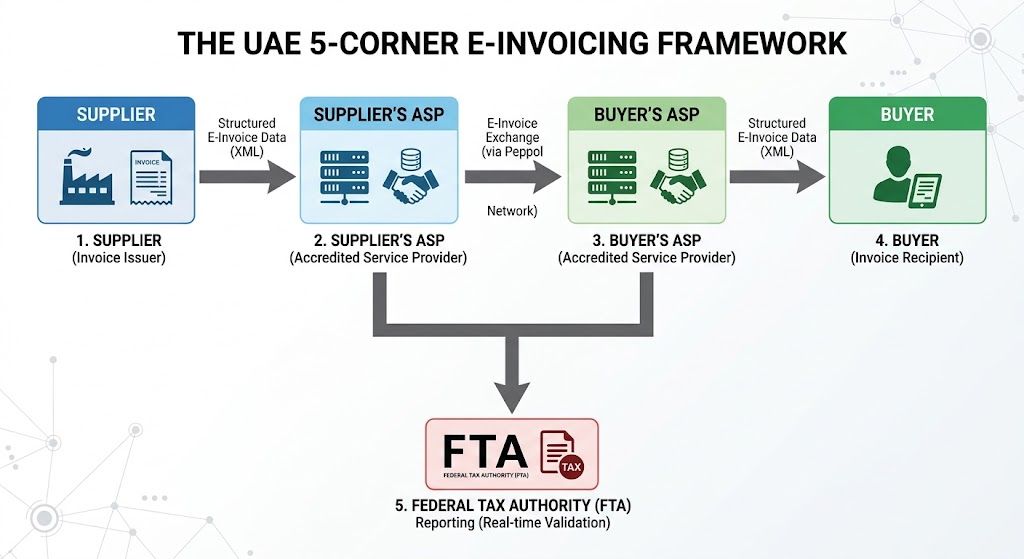
- The Peppol Network: Building custom connections between every supplier and client gets expensive fast. The UAE chose peppol an open international transport standard as its national delivery highway. It functions like a secure universal postal framework that connects different accounting software automatically.
- The 5-Corner Model: Traditional networks connect four points: the seller, the buyer, and their two software gateways. The UAE adds a 5th corner: the Federal Tax Authority (FTA). Whenever an invoice moves between companies, an automated digital summary routes straight to the tax authority at the exact same moment.
- Accredited Service Providers (ASPs): Businesses cannot connect their accounting tools directly to government portals independently. Companies must partner with an officially certified accredited service provider a licensed gateway that verifies data rules, handles security, and routes files safely across the network.
The Countdown: Rollout Timeline & Deadlines
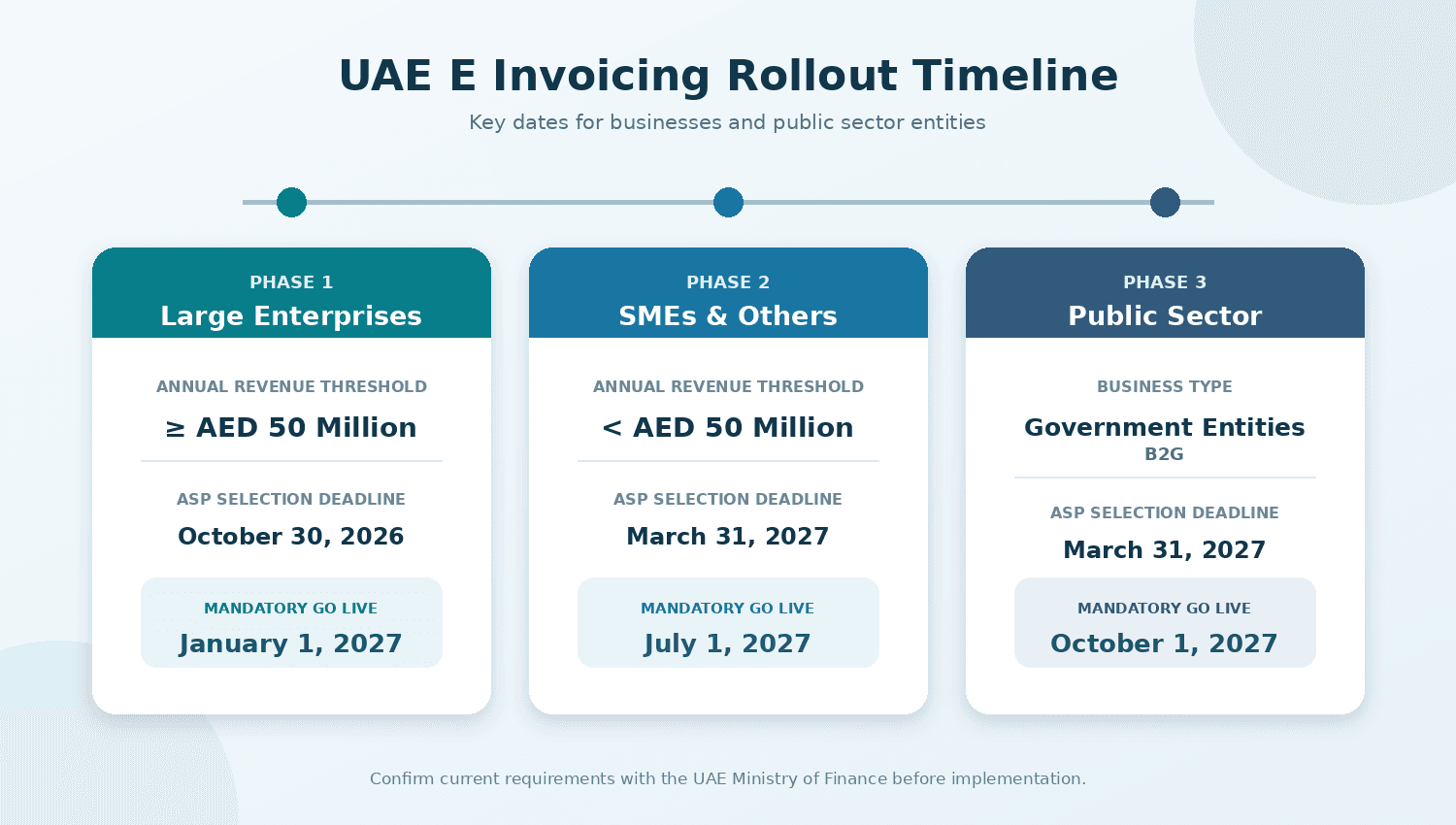
To help organizations transition without operational friction, the Federal Tax Authority is rolling out mandatory phases based on business turnover:
How This Impacts Procurement & Finance Departments
This mandate isn't just an IT upgrade; it directly alters daily workflows across procurement and finance:
Procurement: Bad Data Will Freeze Your Supply Chain
In a real-time digital network, minor errors are costly. A missing building number or a single typo in a supplier's Tax Registration Number (TRN) will cause the Peppol network to reject the invoice instantly. Procurement teams must audit vendor master files today. Onboarding new vendors now requires verifying their software readiness alongside their trade license.
Finance: No Compliant XML = No Input VAT Deduction
For CFOs and accounting managers, compliance protects the bottom line. Under the new regulations, organizations cannot claim Input VAT credit deductions unless purchases are backed by a fully compliant XML invoice routed through an accredited gateway. Manual adjustments and backdated ledger entries will disappear, making real-time accuracy essential.
Interactive Readiness Check: Are You Prepared?
Take two minutes to review these 5 strategic questions with your leadership team:
- Has your organization mapped all fields in your ERP to the UAE PINT-AE specification?
- [ ] Yes, fully mapped and tested.
- [ ] In progress with our ERP vendor.
- [ ] What is PINT-AE?
2. Have you audited your Vendor Master Data for complete TRNs and legal addresses?
- [ ] Yes, 100% verified.
- [ ] Partially done for top 20% vendors.
- [ ] Not started yet
3. Have you selected or shortlisted an Accredited Service Provider (ASP)?
-
[ ] Contract signed / Integrating.
-
[ ] Currently evaluating options.
-
[ ] Haven't looked at ASP vendors yet.
4. Does your procurement workflow enforce supplier readiness checks?
-
[ ] Yes, integrated into onboarding.
-
[ ] Manual checks in place.
-
[ ] No readiness checks currently.
5. Are your procurement and finance staff trained on budgeting and tax compliance changes?
- [ ] Yes, continuous training enrolled.
- [ ] Planning internal workshops.
- [ ] No formal training scheduled.
Scoring Guide: If you checked mostly the first options, your organization is in great shape! If you picked two or more of the bottom options, your team needs an immediate action plan to avoid go-live penalties.
Practical Action Steps to Take Today
- Clean Up Master Records: Audit duplicate vendor entries, fix broken address formats, and double-check TRNs across your database.
- Contract an Accredited Gateway: Select an accredited service provider that integrates smoothly into your existing accounting software or ERP system.
- Reconfigure ERP Export Rules: Update software settings so outgoing billing files automatically export valid PINT-AE XML files.
- Align Purchase Orders: Ensure purchase order lines match incoming electronic invoice formats to prevent automated rejections.
- Upskill Operational Staff: Train procurement, accounts payable, and finance personnel to manage real-time exception handling and digital compliance.
Frequently Asked Questions (FAQs)
What happens if an organization misses the deadline?
Failing to connect with an accredited service provider or issuing non-compliant invoices can result in administrative fines from the FTA. Additionally, corporate clients will be unable to claim Input VAT on non-compliant bills, straining key business relationships.
Can companies still send standard PDF invoices via email?
No. Standard PDF email attachments and paper receipts will no longer count as legal tax documents for B2B or B2G transactions under e invoicing uae rules. Every tax invoice must travel through the official peppol network as a structured XML document.
Does this mandate cover direct retail (B2C) sales?
Not at this stage. The 2027 rollout targets Business-to-Business (B2B) and Business-to-Government (B2G) transactions. Retail (B2C) guidelines will follow in future updates.
What is the primary role of an Accredited Service Provider (ASP)?
An accredited service provider acts as your secure gateway. It converts billing data into valid XML format, verifies details for errors, routes files across peppol, and reports required tax summaries directly to the FTA.
Does the rule apply to UAE Free Zone companies?
Yes. All Free Zone entities subject to Corporate Tax or VAT must comply with the national e-invoicing framework alongside mainland enterprises.
Building Strategic Financial Resilience
Upgrading software solves half the equation; preparing your team solves the rest. When tax workflows go digital, financial decisions move faster, and errors become costlier.
Empower your department heads with industry-leading professional development programs:
- Master strategic sourcing, vendor evaluation, contract structuring, and budget optimization through the Mastering Procurement Budgeting and Cost Management program.
- Bridge the gap between operations and finance with the Finance for non Finance Professionals course, giving non-finance managers the tools to manage budgets, handle tax implications, and protect working capital.
